

the great grief experiment
needs a big god


“We buried our friends in the morning, we protested in the afternoon, and we danced all night.”
- Dan Savage
Whenever someone asks me where to start with grief, I tell them to begin with an experiment.
Heads tilt suspiciously to one side, what….no self-improvement plan, no downward dog challenge, no mountain quest, no guru with the goods, no breathwork cure?
I repeat the street smart advice and permission slip a mentor once gave me; Nah, nothing to fix kid, ya grief just wants to play.
Grief needs no pressure to perform, but it invites your big trust.
Grief needs a big god.
When we lose a way of being, it can feel, temporarily, like the bottom falls out. All the social constructs that held us in place are no longer available. Relationships change. Family systems spin. And our identity and purpose hangs in the air.
Psychologists call it ambiguous grief. Ambiguous because no one can see it.
A grief that results when a person experiences a significant loss and the resultant grief is not openly acknowledged, socially validated, or publicly mourned.’
- Prof Ken Doka
Unlike death, where the absence is final, ambiguous loss leaves you suspended.
It’s doubly weird because no one’s died.
Nobody died, but I’m hit by grief anyway. The kind of disenfranchised grief that’s minimised, and often judged, as a midlife crisis or hormonal imbalance instead of legitimate loss.
This is the grief nobody talks about. The loss that comes from choosing authenticity over approval. From finally putting yourself first and discovering that “first” often means “alone.” You’re grieving the version of yourself that others found comfortable and acceptable.
When you choose values alignment over security, there’s no ceremony for that. No rituals. No rite of passage.
A grief experiment gives us permission to feel and own a new way:
I also have these feelings.
I also feel devastation for what I’ve lost, even when I chose to lose it.
I also miss people & places I can never go back to.
I also am in a relationship, but the energy has gone.
I also am dying in this job where I don’t feel seen.
I’m also full of longing for another way of being.
Frances Weller says “Grief is not a problem to be solved, but a presence awaiting witnessing.”
To improve grief literacy in a western culture that has privatised it as a pathology, we need to experiment. What society has normalised is not natural.
Grief is relational and wired for communal regulation. If it’s not seen or witnessed openly, it stays stuck inside the body or a therapist’s office.
We grieve, yes. But we grieve while creating, while attempting connection, while dancing, while breathing, while bringing it out of isolation. We grieve the experiment by making something natural again.
Big god love…Florence and the Machine; listen here
Much love,
Tina x
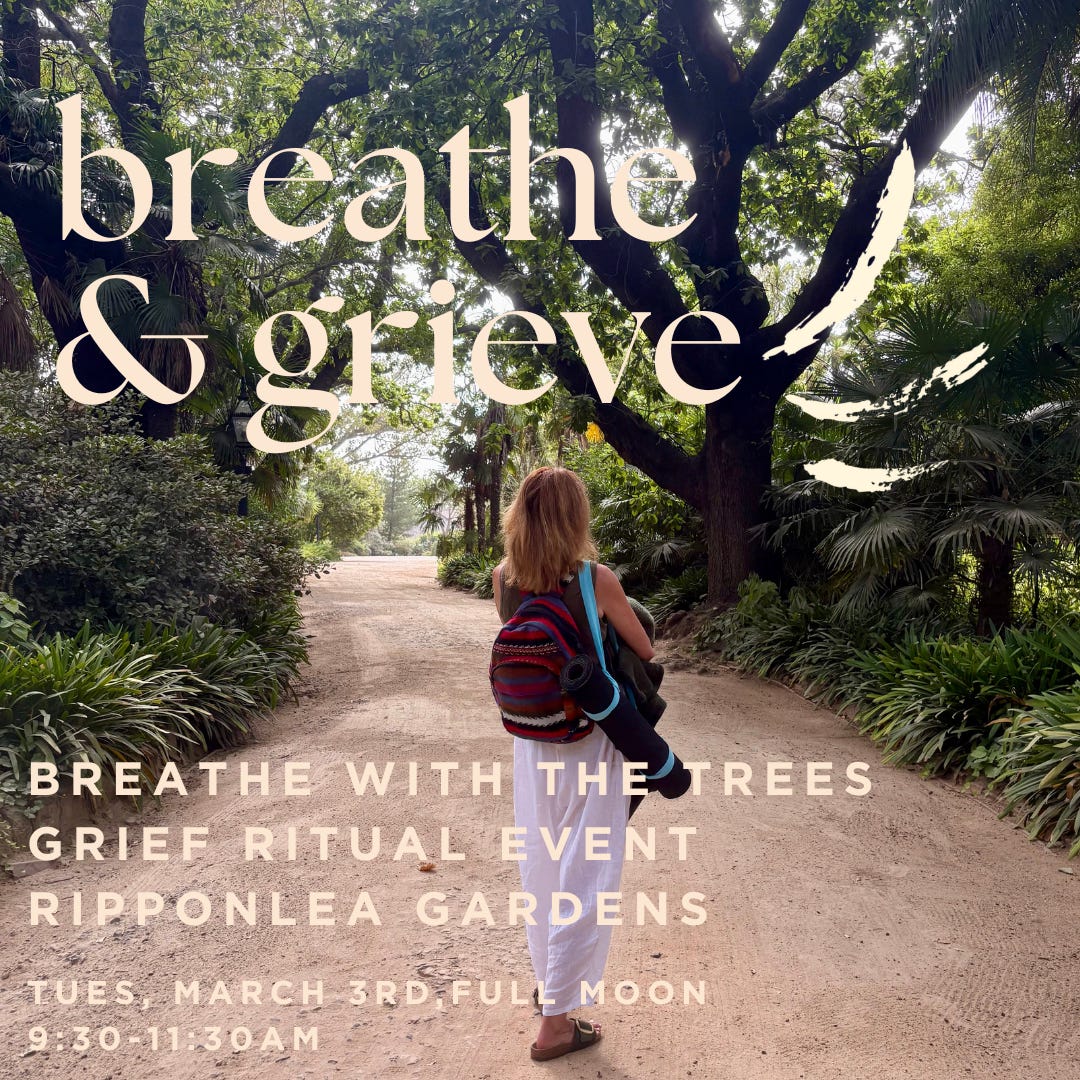
Breathe with the Trees - Ripponlea Gardens
I’ve never led a breathwork journey where grief didn’t show up as the guest of honour. Paving the way for intuition and healing.
If you’ve been questioning your path, feeling disconnected from loved ones who’ve passed, or wondering whether you’re truly supported, this ritual is for you. We return to the trees as our companions through loss, endings and rebirths. Trees exist in constant relationship with one another while remaining fully themselves. Your grief belongs, not as a wound to be healed, but as a landscape you learn to live in.
For the heartbreak that came while the world kept turning.
For the moments we met death and didn’t know how to meet ourselves.
For the rites of passage we crossed without saying goodbye to the younger versions of us.
For the times we collapsed under the weight of another climate catastrophe.
For the frantic days we forgot how to feel in ways that keep us open, fluid, and creative.
*We have private access to the property during this event